

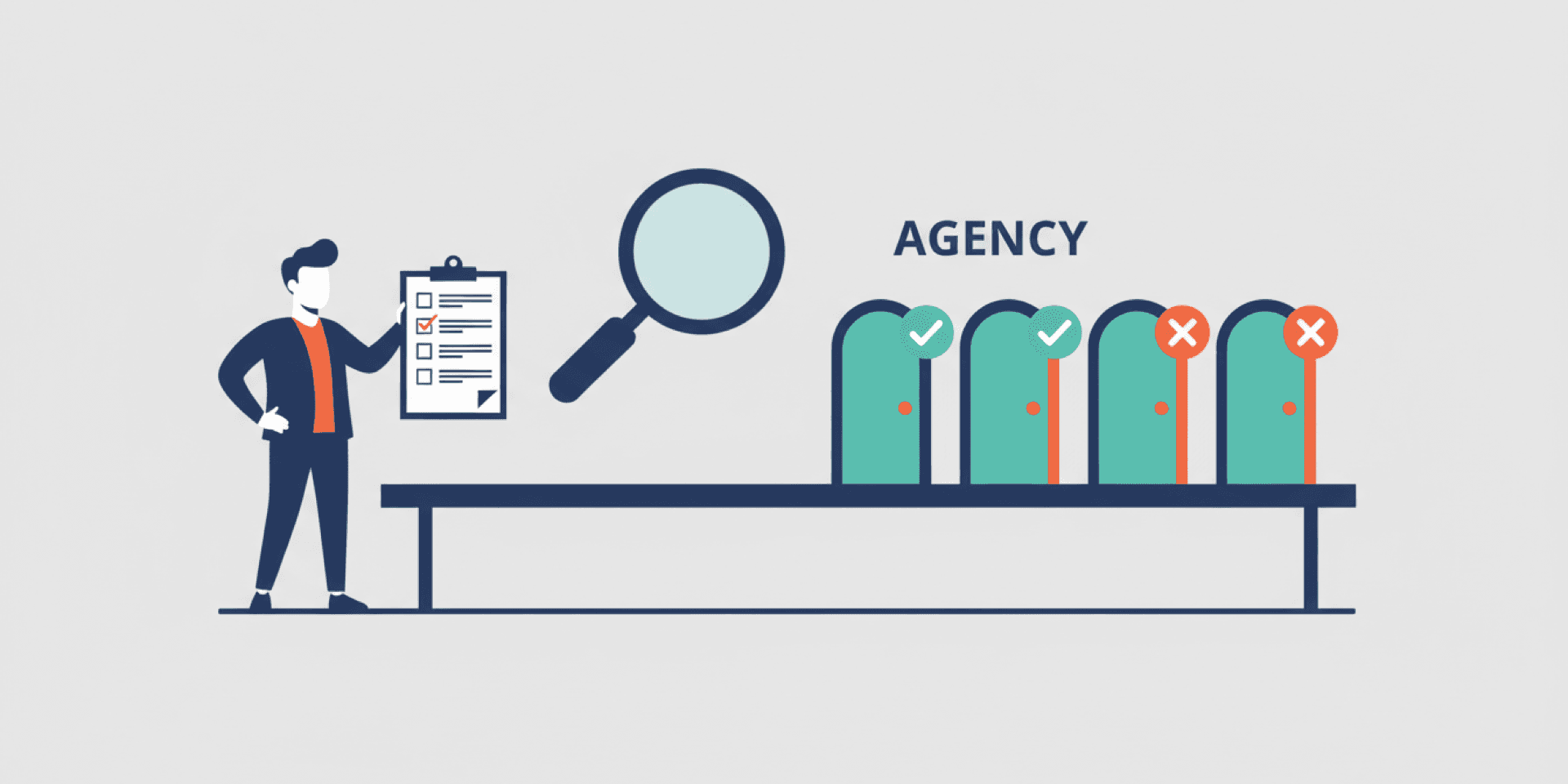
The last time you Googled “how to hire a web development agency,” you probably found advice like “check their portfolio” and “read client reviews.” That guidance wasn’t wrong — it was just written for a different era.
In 2026, the agencies worth hiring have fundamentally changed how they build software. AI-powered development has rewritten the playbook. The problem? Most business owners are still interviewing agencies with questions from 2019. And agencies that can’t keep up are counting on you not knowing the difference.
Here are the questions that actually matter now — and what the answers should sound like.
TL;DR
Hiring a development agency in 2026 means asking about AI workflows, automated testing, code review processes, and cost predictability — not just portfolios and timelines. The best agencies combine human expertise with AI-assisted development and can explain exactly how. Red flags include vague AI claims, no testing process, and promises that “AI will build your entire app.” The questions below are your cheat sheet for separating the serious from the superficial. Ask them before signing anything.
1. “How does your team actually use AI in development?”
This is your opening salvo, and it separates serious agencies from those slapping “AI-powered” on their homepage for marketing points.
A credible answer sounds specific. They should describe which parts of their workflow use AI coding assistants — code generation, automated testing, code review, documentation. They should explain the human oversight layer. They should be able to tell you where AI saves time and where it doesn’t.
A bad answer sounds like buzzwords. “We use AI across our full stack” means nothing. “AI handles everything” is a red flag the size of a billboard. As we explored in our deep dive on questions to ask your agency about AI, specificity is everything here.
What to listen for: Concrete examples. Named tools. Defined boundaries between what AI does and what humans do.
2. “What happens when AI-generated code has a bug?”
Every honest agency will tell you: AI-generated code isn’t perfect. GitHub’s research on AI coding tools shows significant productivity gains — but speed without quality controls is a recipe for technical debt. The question isn’t whether bugs happen. It’s what catches them before your customers do.
The right answer involves quality checks built into the development workflow. Automated testing that runs on every change. Code review processes that combine human judgment with AI-powered analysis. Multiple layers of quality assurance before anything reaches production.
If an agency tells you their AI doesn’t produce bugs, they’re either lying or they’re not actually using AI for anything meaningful.
3. “Can I see your testing process?”
This question makes bad agencies uncomfortable. Good ones light up.
An agency with a mature testing and quality assurance process can walk you through it in plain language. They’ll describe automated tests that verify features work as expected. They’ll explain how they catch regressions — bugs that creep in when fixing or adding something else. They’ll show you that testing isn’t an afterthought bolted on at the end.
If they don’t have a testing process, walk away. Research from NIST found that software bugs cost the U.S. economy billions annually — and the cost of fixing them increases dramatically the later they’re caught. In 2026, shipping code without automated testing is like driving without brakes. You might be fine for a while. But eventually, you won’t be.
4. “What does your code review process look like?”
Code review is where quality and accountability intersect. The gold standard in 2026 is a combination of automated quality checks and human review.
AI-assisted code review catches patterns, security vulnerabilities, and inconsistencies faster than any human can alone. But human reviewers catch intent mismatches — situations where the code works correctly but solves the wrong problem. You need both.
Ask who reviews code. Ask how many sets of eyes see a feature before it ships. Ask what happens when a reviewer flags an issue. The answers tell you everything about how seriously an agency takes quality.
5. “How do you handle the jump from prototype to production?”
This is where most projects quietly fall apart. We’ve written extensively about why AI prototypes aren’t ready for real customers and the 80% problem — where a project looks nearly finished but the last 20% takes longer than the first 80%.
A trustworthy agency acknowledges this gap openly. They’ll describe how they handle security hardening, performance optimization, error handling, and edge cases that prototypes don’t account for. They’ll have a defined process for moving from “it works on my screen” to “it works for ten thousand users at 2 a.m.”
Red flag: Any agency that treats the prototype as the final product.
6. “How do you keep costs predictable?”
The iron triangle of scope, time, and cost hasn’t disappeared — but AI-assisted development has changed how agencies manage it. Good agencies use AI to accelerate development without sacrificing quality, which means better cost predictability for you.
Ask how they scope projects. Ask what happens when scope changes mid-build. Ask how they communicate budget impact before it becomes a surprise on your invoice.
The best agencies will describe clear milestone structures, regular check-ins, and transparent time tracking. PMI research identifies scope creep and unclear requirements as top causes of budget overruns. They’ll also be honest about what can blow up a budget: unclear requirements, mid-project pivots, and skipping the planning phase.
7. “What does post-launch support look like?”
Your app doesn’t end at launch. Neither should your agency relationship.
Ask about maintenance plans. Ask about response times for critical bugs. Ask who monitors performance after launch and how they handle updates when platforms, browsers, or third-party services change.
An agency that disappears after launch day is an agency that built something they don’t want to maintain. That should worry you.
The red flags, summarized
- They can’t explain their AI usage specifically. Vague claims signal vague processes.
- They have no automated testing. Manual-only testing doesn’t scale and misses regressions.
- They promise AI will build your entire app. AI is a tool, not a replacement for experienced developers.
- They skip code review. No review process means no accountability.
- They treat the prototype as the product. The gap between demo and production is where projects die.
- They go silent when you ask about post-launch. If they won’t maintain it, they might not have built it to last.
FAQ
Should I only hire agencies that use AI in their development workflow?
Not necessarily. But you should understand why if they don’t. In 2026, AI-assisted development delivers measurable speed and quality advantages. An agency that’s chosen not to adopt these tools should have a compelling reason — not just “we haven’t gotten around to it.”
How can I tell if an agency is actually using AI or just marketing it?
Ask for specifics. Which tools? At which stages? What does human oversight look like? An agency genuinely using AI can describe their workflow in detail. One that’s just marketing it will give you slogans.
Is it a problem if an agency outsources some work?
Not inherently. But you should know about it upfront. Ask who will actually be building your project, how communication works across teams, and whether quality assurance processes apply equally to in-house and outsourced work.
What’s the most important question on this list?
Question three — about testing. An agency without automated testing will cost you more in bug fixes, delays, and lost customer trust than any upfront savings are worth. Quality assurance isn’t optional anymore.
The bottom line
Hiring a development agency in 2026 isn’t just about finding people who can write code. It’s about finding a team with the processes, tools, and discipline to build something that lasts. The right questions expose whether an agency has genuinely evolved — or just updated their website copy.
In upcoming articles, we’ll cover what to budget for a professional build and why your app doesn’t end at launch. The hiring decision is just the start.
Looking for an agency that can answer every question on this list? Let’s talk about your project — we build with AI-powered development, automated quality assurance, and a team that stays with you long after launch day.