
You had a great discovery call. The client was engaged, the project sounded exciting, and you said all the right things. Then you hung up — and started the slow, painful process of turning that conversation into a proposal.
Three days later, you send it over. The client has already talked to two other agencies. Half the details from the call are paraphrased from memory. A few specifics got lost entirely. The proposal is fine, but it doesn’t feel like a mirror of the conversation — it feels like an approximation.
This is the gap that AI is closing. Not in theory. Right now.
TL;DR
The traditional proposal process takes days and loses context at every step. AI-powered workflows can record a meeting, transcribe it, semantically analyze the conversation, extract requirements, and generate a comprehensive scope document in minutes. The key is combining deterministic processes (recording, transcription) with non-deterministic intelligence (semantic understanding, scope analysis) — then validating the output against the source before a human reviews it. The result: faster proposals, higher close rates, fewer scope creep issues, and institutional memory that never fades. This pattern applies to any business that converts conversations into structured deliverables.
The Real Cost of a Slow Proposal
Most agencies and consultancies treat the proposal phase like an unavoidable cost of doing business. A meeting happens on Monday. Somebody writes notes. Those notes get expanded into a document by Wednesday. Internal review pushes delivery to Thursday or Friday.
By the time the client sees your proposal, they’ve already started forgetting what they told you. Worse — you’ve started forgetting what they told you. The proposal reflects your interpretation of the conversation, not the conversation itself.
The cost isn’t just the hours spent writing. It’s the deals you lose because you were slow, the scope creep that starts because the proposal missed a key requirement, and the back-and-forth revisions that could have been avoided if the first draft had been more accurate.
If you’ve ever wondered what questions to ask before hiring a development agency, one of the most revealing is how they handle the gap between conversation and documentation. The answer tells you a lot about their process maturity.
What an AI-Powered Proposal Workflow Actually Looks Like
Here’s what becomes possible when you apply AI to the meeting-to-proposal pipeline. Not hypothetically — this is how forward-thinking firms are operating today.
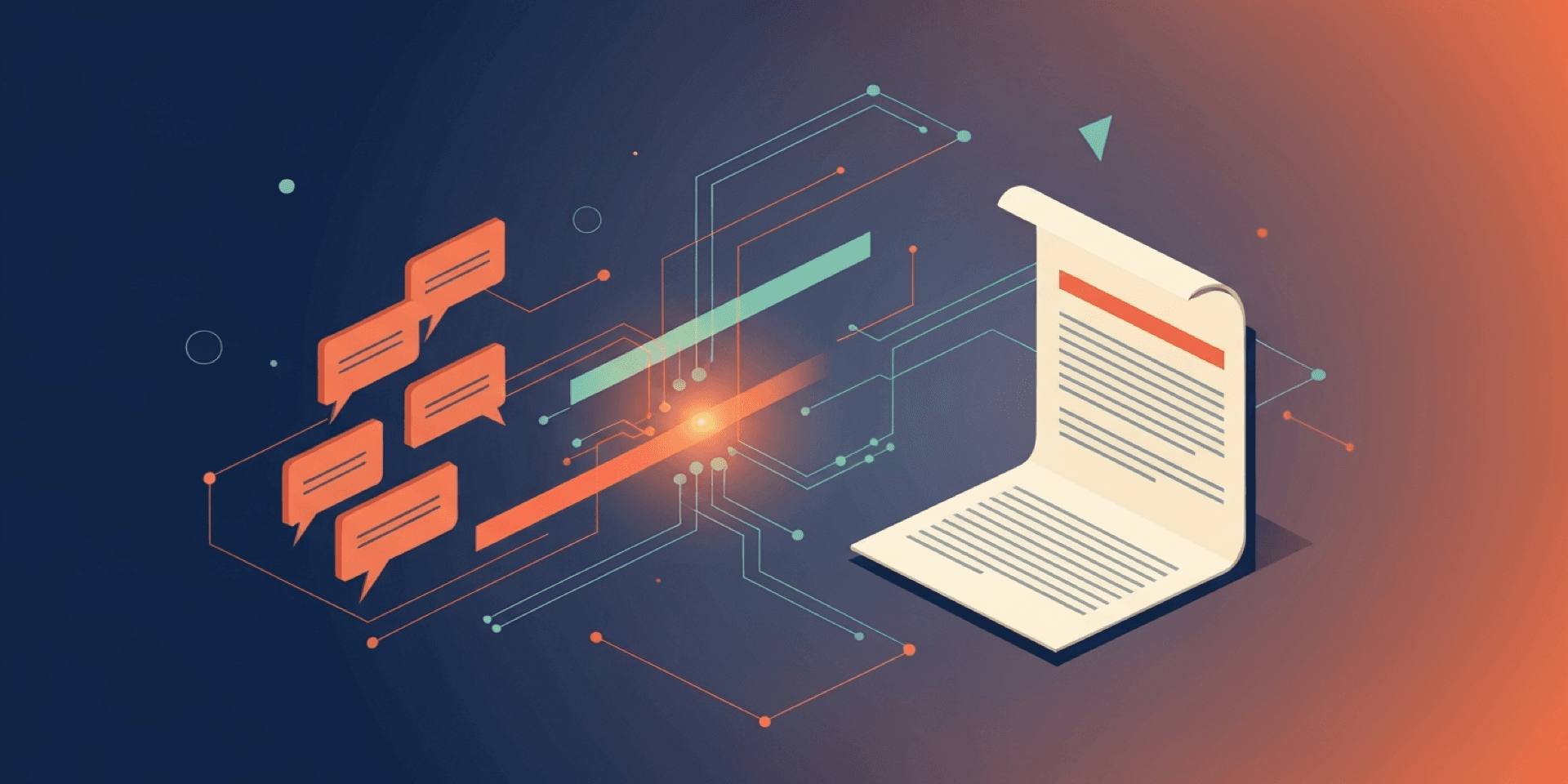
Step one: Capture. The meeting is recorded and transcribed automatically. Not summarized — fully transcribed, word for word. This creates the source of truth that everything else builds from.
Step two: Vectorize. The transcript gets converted into a searchable semantic format. Think of it like indexing a book — except instead of searching by keyword, you can search by meaning. “What did the client say about their budget?” returns every relevant passage, even if the word “budget” was never spoken.
Step three: Analyze. A specialized AI agent reads the full transcript with purpose. It extracts requirements, identifies scope boundaries, flags ambiguities, and estimates complexity. This isn’t a chatbot summarizing a conversation. It’s a purpose-built process that knows what a scope document needs and works backward from that structure.
Step four: Generate. The structured analysis becomes a comprehensive scope document — complete with project phases, deliverables, estimated timelines, assumptions, and exclusions. It reads like a proposal a senior consultant spent hours on, because it was built from the same source material a senior consultant would use. It just happened in minutes.
Step five: Validate. Before any human reviews it, the system checks its own work against the original transcript. Did it miss any requirements the client mentioned? Did it introduce anything the client didn’t discuss? This closed-loop validation catches hallucinations and gaps before they become problems.
Deterministic Meets Non-Deterministic
This workflow works because it combines two types of processes that complement each other perfectly.
The deterministic parts — recording, transcription, structured extraction — are reliable and repeatable. They produce the same output every time for the same input. No judgment required. No creativity needed. Just accurate data capture.
The non-deterministic parts — semantic understanding, scope analysis, document generation — are where AI’s intelligence shines. Understanding that “we need it to work on phones” means mobile-responsive design. Recognizing that a casual mention of “user accounts” implies authentication, password recovery, and data privacy. Connecting dots that a keyword search would miss.
Dan Disler of Agentic Engineer calls this pattern an “AI Developer Workflow” — a structured pipeline where deterministic and non-deterministic processes work together, each handling what it does best. The deterministic steps keep things grounded and auditable. The non-deterministic steps handle the nuance and synthesis that used to require hours of human effort.
Neither type works well alone. Pure automation without intelligence produces rigid output. Pure AI without structure produces unreliable output. The combination is what makes the system trustworthy enough for real business use.
The Closed Loop: AI That Checks Its Own Work
The validation step deserves special attention because it’s what separates a useful system from a dangerous one.
Anyone who has used AI tools knows they can sound confident while being completely wrong. In a proposal context, that means inventing requirements the client never mentioned, or — more commonly — quietly dropping requirements that were discussed but didn’t fit neatly into the AI’s output structure.
A closed-loop system addresses this by having the AI validate its generated document against the original transcript. It’s the equivalent of a consultant re-reading their meeting notes before sending a proposal — except the AI does it systematically, checking every extracted requirement against the source material.
This is also why understanding what AI-powered actually means matters so much. The value isn’t in the AI generating text. It’s in the system design around that generation — the guardrails, validation, and human review checkpoints that make the output reliable.
Why Speed Wins Deals
There’s a direct relationship between proposal speed and close rates. The first agency to send a comprehensive, accurate proposal has a massive advantage — not because clients are impatient, but because responsiveness signals competence.
When a client receives a detailed proposal within hours of a discovery call — one that accurately reflects what was discussed, with clear scope and pricing — it communicates something powerful. This team listens. This team can execute.
Compare that to the agency that sends a generic-looking proposal five days later with a few details from the call sprinkled in. Same expertise, same capabilities, dramatically different first impression.
The accuracy component matters just as much as speed. A fast proposal that misses key requirements is worse than a slow one that gets everything right. But a fast proposal that also gets everything right? That’s the competitive advantage AI enables.
If you’ve ever wondered how to budget properly for a software build, you know that accurate scoping upfront prevents the most expensive problems downstream. Proposals generated from semantic analysis of actual conversations are inherently more accurate than proposals written from memory and shorthand notes.
Institutional Memory That Never Fades
Here’s a benefit that compounds over time: every meeting transcript becomes a searchable, permanent record.
Six months into a project, the client says “we discussed this in the original meeting.” In a traditional workflow, someone digs through email threads and note files hoping to find the reference. In a vectorized system, you search semantically and find the exact passage in seconds.
A year later, the same client comes back for a new project. Instead of starting from scratch, you search your meeting archive. Every preference they expressed, every constraint they mentioned, every priority they outlined — it’s all still there, instantly retrievable.
This is institutional memory that doesn’t walk out the door when an employee leaves. It doesn’t degrade over time. It doesn’t get lost in someone’s personal notes folder. And it gets more valuable the longer you use it.
Beyond Proposals: The Pattern That Applies Everywhere
The meeting-to-proposal workflow is one application of a universal pattern: capture, vectorize, analyze, generate. Once you recognize the pattern, you see it everywhere.
Sales calls to CRM updates. Instead of a sales rep spending 15 minutes after every call logging notes in the CRM — or, more realistically, not doing it — the call transcript gets analyzed automatically. Contact details, discussed needs, next steps, and deal stage updates flow into the CRM without manual entry.
Support calls to ticket creation. A customer calls with an issue. The transcript gets analyzed for the problem description, steps to reproduce, and severity. A structured ticket appears in the queue before the agent has finished their post-call notes.
Strategy sessions to action plans. A leadership team spends two hours in a planning session. Instead of someone spending another two hours writing up the takeaways, the transcript produces a structured action plan with owners, deadlines, and dependencies — validated against who actually committed to what during the meeting.
Board meetings to executive summaries. Decisions made, action items assigned, and topics deferred — structured and delivered to every board member as the same accurate record, regardless of their note-taking habits.
The pattern scales because the underlying technology is the same. What changes is the output template and the domain-specific analysis. A proposal analyzer knows what scope documents need. A CRM updater knows what fields matter. A ticket creator knows what support teams need to triage.
What This Means for Your Business
If you run an agency, consultancy, or any professional services firm, the gap between “meeting happens” and “deliverable ships” is where you lose money, lose clients, and lose accuracy. AI doesn’t eliminate the human judgment needed to finalize a proposal or close a deal. But it eliminates the hours of mechanical work between the conversation and the deliverable.
The businesses that figure this out first will close faster, scope more accurately, and build a knowledge base that compounds with every client interaction. The ones that don’t will keep writing proposals from memory and wondering why their close rate isn’t improving.
This isn’t a technology story. It’s a process story. The AI is the engine, but the value comes from the workflow design — knowing which steps to automate, where to validate, and when to bring humans into the loop. If you’re interested in how this kind of thinking applies to building software, understanding the gap between a prototype and a production-ready product is a great place to start.
FAQ
Does AI replace the need for human review of proposals?
No. AI generates a strong first draft from the actual conversation, but a human should always review the final document before it goes to a client. The value is in eliminating the hours of manual drafting work, not in removing human judgment. Think of it as going from a blank page to a 90% complete draft — instantly.
What about meetings that aren’t recorded?
The system requires a transcript, so recording is essential. Most clients are comfortable with meeting recording when you explain that it helps you deliver a more accurate proposal faster. The recording itself can be deleted after transcription if privacy is a concern — the searchable transcript is what the system needs.
Is this only useful for large firms?
It’s actually more impactful for small firms and solo consultants. Larger organizations have dedicated sales operations teams to handle proposal writing. A solo consultant or small agency typically has the same people selling and delivering — which means every hour spent writing proposals is an hour not spent on billable work. Automating the proposal pipeline gives small firms the responsiveness of a large operation.
How accurate are AI-generated proposals compared to manually written ones?
When built on a full transcript with semantic analysis and closed-loop validation, they tend to be more accurate — because they’re working from the complete conversation rather than someone’s memory and shorthand notes. The most common source of proposal errors is human recall, and AI eliminates that variable entirely.
Ready to Work Smarter?
At Project Assistant, we build intelligent systems that turn messy, manual processes into streamlined workflows — from client-facing applications to internal operations. If you’re interested in how AI can transform your business processes, let’s talk about what’s possible.