


TL;DR
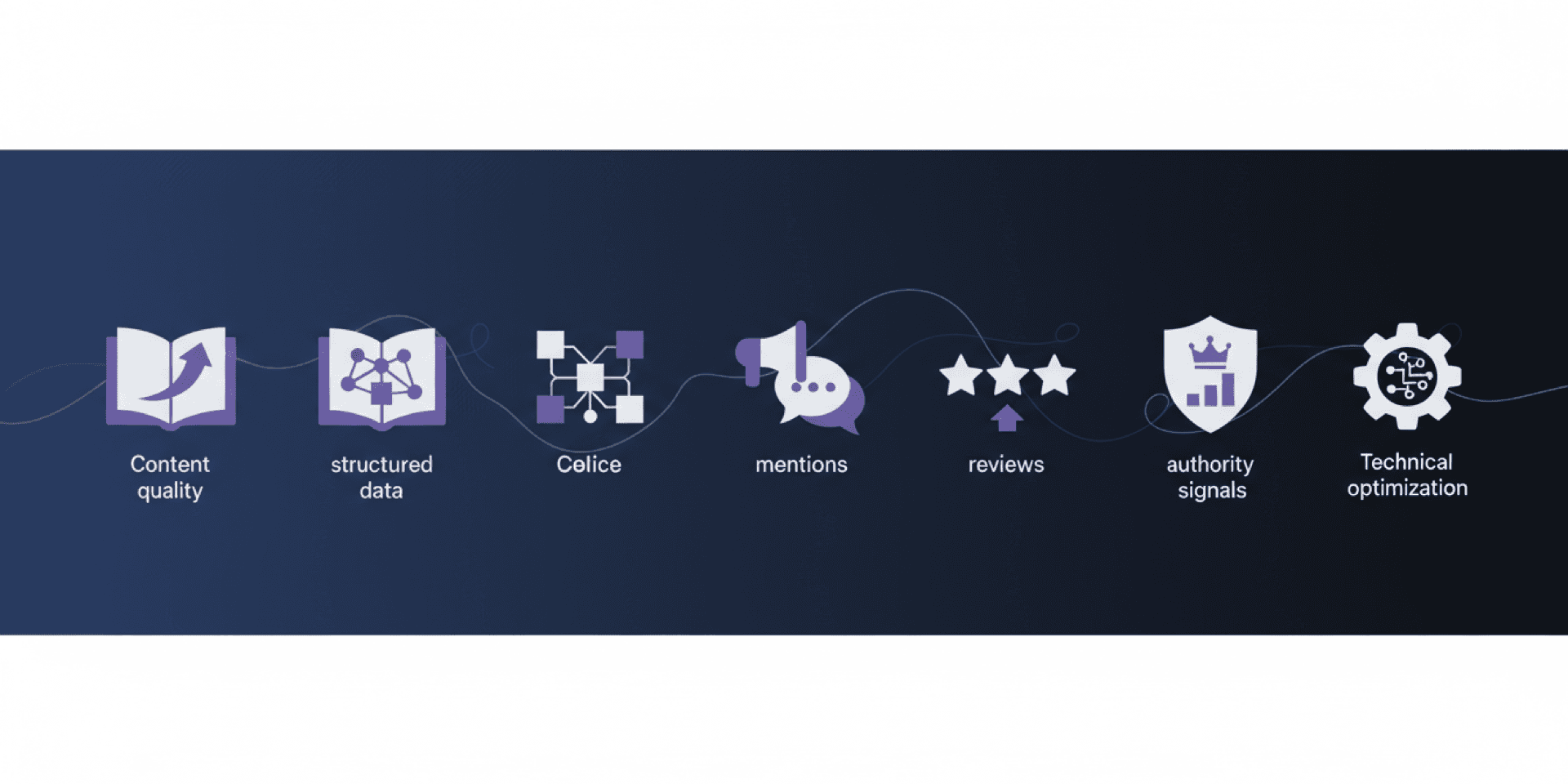
Getting your brand recommended by AI isn’t luck — it’s strategy. These six GEO best practices cover the full spectrum of what AI models look for when deciding who to recommend: authoritative content, third-party validation, technical infrastructure, direct-answer formatting, reputation signals, and consistent measurement. Research shows these optimization methods can improve AI visibility by 30-40%. Each strategy compounds on the others, so the businesses that execute across all six will see dramatically better AI visibility than those focused on just one or two.
The playbook AI models reward
There’s no secret trick to GEO. AI models recommend brands they trust, and they build that trust from specific, identifiable signals across the web. The good news? Those signals are entirely within your control.
We’ve spent the past several weeks breaking down what GEO is, how AI search is reshaping discovery, and the specific signals that drive AI recommendations. This post pulls it all together into an actionable playbook.
Here are the six strategies that matter most — backed by data and industry research on what actually moves the needle.
1. Publish authoritative, fact-dense content
AI models prioritize content that teaches over content that sells. The single most impactful thing you can do for GEO is publish content that demonstrates genuine expertise — with specifics, data, and original perspective.
Research on GEO optimization methods shows that content with statistics, citations, and verifiable claims can improve AI visibility by 30-40% compared to generic marketing copy. AI models aren’t impressed by vague authority claims. They’re impressed by specifics.
What this looks like in practice:
Lead with facts, not feelings. “Our clients see 40% faster load times” beats “We build really fast websites.” AI can cite the first statement. The second is just marketing.
Cover topics comprehensively. AI models favor content that fully addresses a topic over content that scratches the surface. If you’re writing about a subject, go deep enough that a reader (or an AI) wouldn’t need to go elsewhere for answers.
Publish consistently. A single great article helps. A consistent body of authoritative content across your specialty establishes topical authority — the kind of pattern AI models recognize and reward.
2. Earn third-party mentions across diverse sources
We covered this extensively in our piece on why third-party mentions are the new backlinks: 85% of brand mentions in AI-generated answers come from third-party pages, and brands in the top 25% for web mentions get 10x more AI visibility.
The strategy is straightforward: make your brand visible across the independent sources AI models trust.
Claim profiles on major review and directory platforms. G2, Clutch, Capterra, Google Business Profile — wherever your industry’s buyers look. Brands with profiles on structured review platforms have 3x higher ChatGPT citation rates.
Earn editorial mentions. Pitch for industry roundups, contribute guest content, pursue media coverage. AI models weight editorial mentions heavily because publication implies vetting.
Engage in community platforms. Reddit, Quora, and industry-specific forums generate nearly half of AI citations. Authentic community participation — answering questions, contributing expertise — creates organic mentions that AI values highly.
3. Implement structured data and technical GEO
Mentions tell AI you’re credible. Structured data tells AI exactly what you do. Together, they give AI models everything needed to recommend you with confidence.
The technical foundation includes:
JSON-LD schema markup. Organization schema on your homepage, FAQ schema on content pages, Service schema on service pages. This removes ambiguity — AI doesn’t have to guess what your business does when you’ve declared it in machine-readable format.
Clean content hierarchy. Proper H1-H2-H3 heading structure, semantic HTML elements, and logical content organization. AI models parse structured content more effectively than unstructured content.
llms.txt protocol. An emerging standard that provides a direct communication channel between your website and AI crawlers. It’s lightweight to implement and signals technical sophistication.
4. Format content for direct AI extraction
AI models generate answers by extracting and synthesizing information from web content. The easier you make it for AI to extract clear answers from your pages, the more likely your content ends up in AI-generated responses.
Use question-based headings. When your H2 or H3 is a question buyers actually ask, and the first paragraph directly answers it, you’ve created a perfect extraction target for AI. The heading acts as the query match, and the paragraph acts as the answer.
Keep answers concise and factual. The first 2-3 sentences after a heading should deliver the core answer without filler. AI models prefer content that gets to the point. Expand with detail afterward — but lead with the direct answer.
Include FAQ sections. Every service page and most blog posts should include a structured FAQ section. These are some of the highest-performing content blocks for AI citation because they mirror the question-answer format AI uses natively.
5. Build and protect your online reputation
AI models don’t just check whether your brand is mentioned — they evaluate how it’s mentioned. Positive sentiment across reviews, ratings, and editorial mentions translates directly into more favorable AI recommendations.
Actively manage reviews. Respond to reviews on Google, Clutch, G2, and industry-specific platforms. A pattern of positive reviews with thoughtful responses signals a trustworthy business. Reputation signals compound over time — consistent positive feedback builds the kind of sentiment AI reflects in its recommendations.
Monitor brand sentiment. Use Google Alerts at minimum, or tools like Brand24 and Mention for deeper tracking. When negative mentions appear, address them promptly. AI models absorb the overall sentiment ratio — you want that ratio strongly positive.
Generate case studies and testimonials. Documented results with specific outcomes (revenue increases, time savings, performance improvements) give AI concrete evidence of your capability. Numbers and specifics carry more weight than general praise.
6. Measure, track, and iterate
You can’t optimize what you can’t measure. A systematic approach to measuring your AI visibility tells you which strategies are working and where to focus next.
Run regular AI audits. Test 15-20 buyer queries across ChatGPT, Gemini, and Perplexity monthly. Track your citation frequency, source inclusion rate, and brand sentiment over time.
Correlate efforts with outcomes. When you publish new content, earn a new directory mention, or add structured data, note it in your tracking. Over time, you’ll see which actions move the needle most for your specific business.
Monitor competitors. Track 3-5 competitors using the same query set. When competitors start appearing where they previously didn’t, investigate what changed. Your competitive intelligence feeds directly into strategy refinement.
Frequently asked questions
Which of these six strategies should I start with?
Start where you have the biggest gaps. If you have zero structured data, that’s the fastest technical win. If you’re invisible on review platforms, directory profiles are quick to set up. Most businesses benefit from starting with strategies 2 (third-party mentions) and 3 (structured data) simultaneously — they’re independent workstreams that compound when combined.
How long before I see results from GEO?
Expect 30-90 days for initial improvements, depending on your starting point and the strategy. Structured data and directory profiles can show impact within weeks on search-augmented AI tools like Perplexity. Content authority and mention-building are longer plays that compound over 3-6 months. As we explained when we first covered signs of AI invisibility, the sooner you start, the sooner the compounding begins.
Do I need to do all six strategies at once?
No — but the strategies compound on each other. A brand with great content but no third-party mentions will underperform. A brand with strong mentions but no structured data is leaving signal on the table. Prioritize based on gaps, but work toward coverage across all six over time.
Is GEO separate from SEO, or do they overlap?
They overlap significantly. Many GEO best practices (authoritative content, structured data, clean site architecture) also benefit traditional SEO. The main additions are the emphasis on third-party mentions, AI-specific formatting, and direct visibility tracking. We broke down the full relationship in our GEO vs SEO comparison.
The bottom line
GEO isn’t one tactic — it’s a system. The brands that win AI recommendations are the ones executing across all six dimensions: content authority, third-party validation, technical infrastructure, answer-ready formatting, reputation management, and measurement. Each strategy strengthens the others, creating a compounding effect that builds over time.
Start with your biggest gaps, execute consistently, and measure the results. The data will guide your priorities.
Want a team that executes all six strategies for you? Our generative engine optimization services cover the complete GEO playbook — from technical implementation to third-party mention strategy to ongoing visibility tracking.