


TL;DR
SEO gets you ranked in Google. GEO gets you recommended by AI. They’re not competing strategies — they’re complementary layers of the same visibility stack. SEO targets traditional search results with keywords, backlinks, and on-page optimization. GEO targets AI-generated answers with brand authority, third-party mentions, structured data, and reputation signals. Skip either one and you’re leaving real visibility on the table. The smartest move for your business right now? Build strong SEO as your foundation and layer GEO on top.
The question every business owner is asking right now
If you’ve been paying attention to the search landscape lately, you’ve probably heard the term “GEO” thrown around alongside the SEO strategies you already know. And the natural first question is: do I need to replace my SEO strategy with GEO?
Short answer: no. Longer answer: you need both, and understanding why is going to save you a lot of wasted effort and budget.
SEO and GEO solve different problems on different platforms. But they share enough DNA that a smart strategy addresses both at once — without doubling your workload. Let’s break down what each one actually does, where they differ, and how to make them work together.
What SEO does (and why it still matters)
You probably know this one, but it’s worth a quick refresher because the foundation matters.
Search engine optimization (SEO) is the practice of improving your website so it ranks higher in traditional search engine results — primarily Google, but also Bing, Yahoo, and others. When someone searches “best web development agency,” SEO determines whether your site shows up on page one or page five.
The key signals include keyword relevance, backlinks, site speed, mobile-friendliness, content quality, and on-page structure (title tags, headings, meta descriptions). It’s a mature discipline with decades of established best practices.
And here’s the thing: SEO still drives the majority of organic website traffic. Google processes billions of searches daily. If you abandon SEO, you lose a massive traffic channel that’s still very much alive.
What GEO does (and why it’s now essential)
Generative engine optimization (GEO) is the practice of positioning your brand so that AI-powered platforms — ChatGPT, Google Gemini, Perplexity, Microsoft Copilot — cite or recommend you when users ask questions.
Unlike SEO, where you’re competing for a spot on a list of links, GEO is about making it into the answer itself. When a buyer asks an AI, “What agency should I hire for mobile app development?” — the AI synthesizes information from across the web and generates a direct response. Your brand is either mentioned or it’s not. There’s no page two.
We covered this in depth in our complete guide to generative engine optimization, but the short version: GEO cares about brand authority, third-party mentions, structured data, online reputation, and content that AI can easily parse and trust.
The real differences (side by side)
Here’s where it gets interesting. SEO and GEO overlap in some areas but diverge sharply in others:
What you’re targeting. SEO targets search engine results pages (SERPs). GEO targets AI-generated answers. One gives you a link in a list. The other gets your brand named in a conversation.
How you’re evaluated. Search engines rank your pages based on keywords, backlinks, and technical factors. AI engines evaluate your brand based on authority, sentiment, consistency, and how widely you’re mentioned across trusted sources. As Search Engine Land puts it, SEO is about getting found — GEO is about getting featured.
What success looks like. SEO success means rankings, organic traffic, and click-through rates. GEO success means citation frequency — how often AI platforms mention your brand, cite your content, or recommend your services when users ask relevant questions.
The content approach. SEO content is optimized around target keywords with proper heading hierarchy and internal linking. GEO content is structured to directly answer questions with clear, authoritative, citable information. SEO asks, “Will Google rank this?” GEO asks, “Would an AI confidently recommend this?”
The authority signals. In SEO, backlinks are king — other sites linking to yours signals trust. In GEO, third-party mentions are the equivalent. Being referenced on “best of” lists, review platforms, and industry publications tells AI models your brand is worth recommending. Think of mentions as the new backlinks.
Where SEO and GEO overlap
Here’s the good news: these strategies aren’t as separate as they might seem. There’s significant overlap, and that overlap is where your investment goes furthest.
Quality content wins both games. Well-written, authoritative content that answers real questions performs well in Google and gets cited by AI. This is the single biggest overlap — and the best reason to invest in content that’s genuinely useful rather than keyword-stuffed.
Structured data helps everyone. Schema markup, clean HTML, and organized heading hierarchy make your content easier for search engines to index and easier for AI models to parse. One implementation, two benefits.
Brand authority compounds. A strong brand reputation — positive reviews, industry mentions, consistent information — helps your SEO (Google’s E-E-A-T signals) and your GEO (AI trust signals) simultaneously.
Technical foundations are shared. Fast load times, mobile optimization, secure hosting, and crawlable site architecture matter for both search engines and the web scrapers that feed AI models their training data.
Why you can’t afford to skip either one
Here’s the scenario if you only do SEO: You rank well on Google, but when a potential customer asks ChatGPT for recommendations in your space, your competitors get mentioned and you don’t. You’re invisible to a growing segment of buyers.
Here’s the scenario if you only do GEO: AI platforms mention your brand, but when people search for you on Google to learn more, your website is buried on page three. The AI-driven interest doesn’t convert because your search presence can’t back it up.
Neither scenario is great. You need both.
And the research backs this up. Gartner predicts traditional search volume will drop 25% by 2026 as users shift to AI-powered discovery. But that still leaves 75% of search happening the traditional way. Walking away from either means walking away from business.
How to build an integrated SEO + GEO strategy
The practical approach isn’t “do two separate strategies.” It’s to build one integrated strategy that serves both. Here’s how:
Start with SEO as the foundation. Your website needs solid technical SEO, keyword-optimized content, and a healthy backlink profile. This is non-negotiable. It’s also what gives AI models a strong signal about your authority.
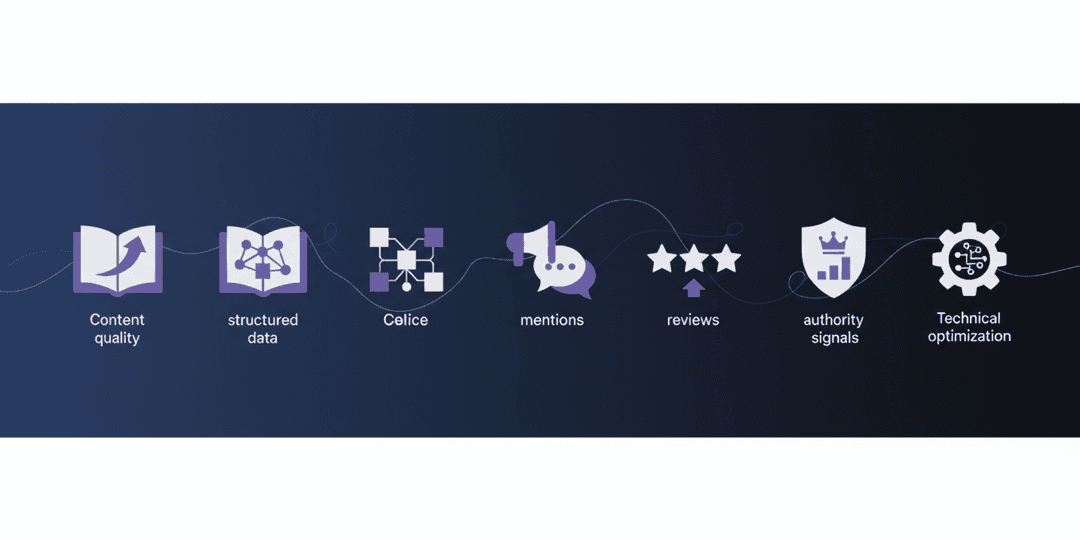
Layer GEO-specific tactics on top. Once your SEO foundation is solid, add the GEO layer: build third-party mentions, optimize content for AI comprehension (direct answers, clear structure, citable facts), implement AI-friendly protocols, and actively manage your online reputation.
Create content that serves both. Write blog posts and guides that target search keywords and directly answer the questions buyers ask AI. This post is a perfect example — it targets “GEO vs SEO” as a keyword while also being the kind of clear, authoritative content an AI would cite.
Track both scorecards. Monitor your Google rankings and organic traffic (SEO metrics) alongside your AI citation frequency and brand mention growth (GEO metrics). The businesses that track both will see the full picture.
Frequently asked questions
Is GEO replacing SEO?
No. GEO is a complementary strategy, not a replacement. Traditional search still drives the majority of organic traffic and will continue to for the foreseeable future. But AI-driven discovery is growing fast, and brands that ignore it are ceding ground to competitors who don’t.
Can I do GEO without changing my SEO strategy?
Partially. Many SEO best practices — quality content, structured data, brand authority — support GEO naturally. But GEO also requires specific tactics like third-party mention building and AI visibility monitoring. The best results come from an integrated approach.
How do I measure GEO performance separately from SEO?
Track AI-specific metrics: how often your brand is cited by ChatGPT, Gemini, and Perplexity for your target queries; your source inclusion rate in AI-generated answers; and the growth of third-party mentions across the web. These are distinct from traditional SEO metrics like rankings and organic traffic.
Which should I invest in first if I have limited budget?
SEO first. It’s your foundation, and it also supports your future GEO efforts. Once your site is technically sound and ranking for key terms, start layering GEO tactics — they’ll compound on the authority you’ve already built.
The bottom line
SEO and GEO aren’t an either-or decision. They’re two layers of the same visibility strategy — one for search engines, one for AI engines. The brands that figure out how to do both well are the ones that will own the next decade of digital discovery.
Treat your SEO as the foundation it’s always been, and start building GEO on top of it now — while the early-mover window is still open.
Want to see where your brand stands in both traditional and AI search? Explore our generative engine optimization services and let’s map out a strategy that covers both.