


TL;DR
Generative engine optimization (GEO) is how you get your brand recommended by AI platforms like ChatGPT, Gemini, and Perplexity — not just ranked on Google. While traditional SEO focuses on earning clicks from search results, GEO focuses on earning mentions inside AI-generated answers. The signals are different (think brand authority and third-party mentions over backlinks), the metrics are different (AI citation frequency over click-through rate), and the stakes are massive. Buyers are already using AI to research purchases. If your brand isn’t in those answers, your competitors are.
Your customers stopped Googling. Well, sort of.
Here’s what’s actually happening: a growing number of your potential customers are skipping the search bar entirely and going straight to AI. They’re opening ChatGPT and asking, “What’s the best agency for building a web app?” They’re asking Perplexity, “Who does great UX design?” They’re asking Gemini to recommend a marketing partner.
And the AI doesn’t show them ten blue links. It gives them an answer. A short list of brands it trusts. Maybe three names. Maybe five.
If your business isn’t one of those names, you don’t get a consolation prize. You get nothing. The buyer doesn’t even know you exist.
That’s the world we’re living in now. And it’s why generative engine optimization matters more than almost anything else you could invest in for your digital presence this year.
This guide breaks down what GEO actually is, how it’s different from SEO, why it’s urgent, and what you can do about it — starting today.
What is generative engine optimization?
Generative engine optimization (GEO) is the practice of optimizing your brand’s online presence so that AI-powered platforms recommend you when users ask for solutions.
We’re talking about the big players: ChatGPT, Google Gemini, Perplexity, Microsoft Copilot, and the AI Overviews that now appear at the top of Google search results. These platforms don’t work like traditional search engines. They don’t crawl the web and rank pages. They synthesize information from thousands of sources and generate a direct answer.
When a startup founder asks an AI assistant, “What companies build the best mobile apps?” — the AI pulls from everything it knows: your website content, third-party reviews, industry mentions, structured data, brand sentiment. Then it decides whether to include you in its answer.
That decision-making process is what GEO targets.
In the traditional search model, you earned a click. In the generative model, the AI provides the answer directly — and your brand either makes the cut or it doesn’t. There’s no page two. There’s no “ranking #7.” You’re either recommended or you’re invisible.
GEO is sometimes called AI search optimization or answer engine optimization. Whatever you call it, the goal is the same: become the brand that AI trusts enough to recommend.
How GEO differs from traditional SEO
If you’ve invested in SEO (and you should — it still matters), you already understand the basics of getting found online. But GEO plays by different rules. Here’s the breakdown:
Different goal. SEO gets your web pages ranked in search results. GEO gets your brand cited inside AI-generated answers. One earns clicks. The other earns recommendations.
Different signals. SEO leans heavily on backlinks, keyword optimization, and on-page factors. GEO cares more about brand authority, third-party mentions, structured data, and online reputation. An AI doesn’t count your backlinks — it evaluates whether trusted sources across the web vouch for you.
Different metrics. In SEO, you track rankings, click-through rates, and organic traffic. In GEO, you track how often AI platforms mention your brand, cite your content, or recommend your services. It’s a different scoreboard entirely.
They’re complementary, not competing. Here’s the good news: strong SEO actually supports GEO. Authoritative content, clean site structure, and solid domain authority are signals that both search engines and AI models respect. The smartest strategy is an integrated approach that covers both.
Think of it this way — SEO is your foundation. GEO is the new floor you’re building on top of it.
Why GEO matters now — not “eventually”
This isn’t a “keep an eye on it” situation. The shift is already happening, and the businesses that move first are going to be very hard to catch. Here’s why the urgency is real:
AI adoption is through the roof. Hundreds of millions of people use generative AI tools every week. And these aren’t just casual users — they’re the same business owners, product managers, and marketing leaders who used to spend hours researching vendors on Google. Now they ask an AI and get an answer in seconds.
Google itself is going generative. Google’s AI Overviews now sit at the top of search results for a growing number of queries. That means even if you rank #1 organically, an AI-generated summary might answer the searcher’s question before they ever see your listing. Your hard-won SEO position just lost some of its punch.
Early movers win big. Generative engines draw from a relatively small pool of authoritative sources. Brands that build strong signals now will be significantly harder to displace later — just like the early SEO adopters who dominated Google rankings for years. The window to establish yourself is open right now, but it won’t stay open forever.
The numbers tell the story. Gartner predicts a 25% decline in traditional search engine volume by 2026 as users shift to AI-powered discovery. Meanwhile, research from Princeton University found that top GEO optimization methods can improve AI visibility by 30-40%. The trajectory is clear.
The signals that drive AI recommendations
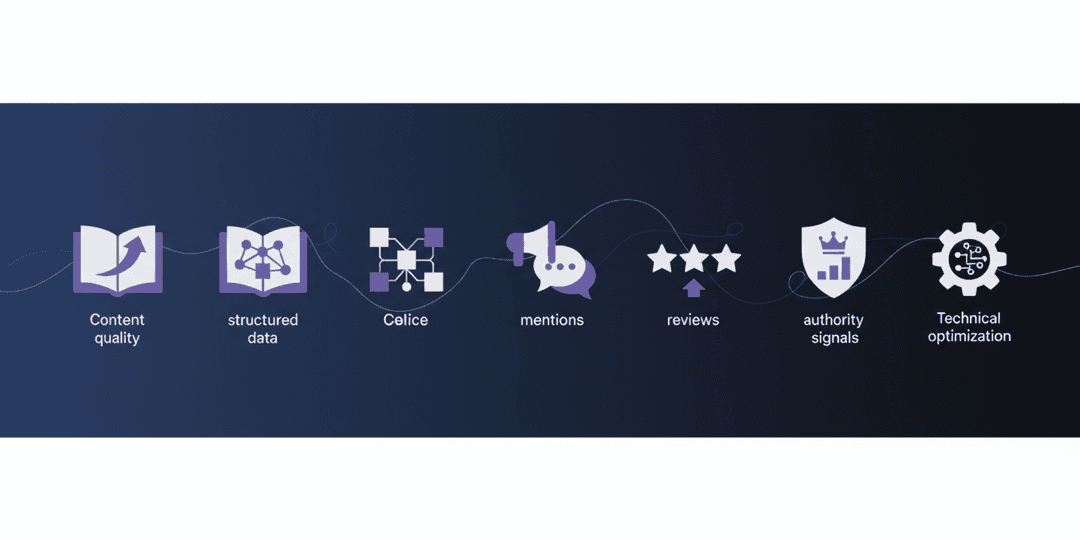
So what actually makes an AI recommend your brand over someone else’s? Here are the key signals that generative engines evaluate:
Authoritative, well-structured content. AI engines favor content that directly and clearly answers specific questions. Think clear headings, concise paragraphs, and information that reads like a trusted resource — not a sales pitch. Structure matters as much as substance.
Third-party mentions and brand authority. This is the big one. Generative engines don’t just read your website — they look at what the rest of the internet says about you. Mentions on industry publications, “best of” lists, review platforms, and directories carry serious weight. Think of third-party mentions as the new backlinks.
Structured data and schema markup. JSON-LD schema, FAQ markup, and clean HTML hierarchy make your content easier for AI models to parse. The more machine-readable your content is, the more likely it gets surfaced. This is where technical chops matter — and where a lot of marketing-only agencies fall short.
Online reputation and reviews. AI factors in your review scores and the overall sentiment around your brand. If your Google reviews, Clutch profile, or industry ratings are strong, that’s a signal. If they’re weak or nonexistent, that’s a signal too — just not the kind you want.
Consistent entity information. Your brand name, address, descriptions, and key details need to be consistent everywhere they appear online. Conflicting information confuses AI models and hurts your chances of being recommended.
Fresh, regularly updated content. LLMs tend to favor newer content. Regularly refreshing your key pages with current, relevant information signals that you’re active, authoritative, and worth recommending.
How to get started with GEO
The good news? You don’t need to overhaul everything overnight. Here’s a practical starting point:
Step 1: Audit your current AI visibility. Start by asking ChatGPT, Gemini, and Perplexity the questions your customers would ask. “Best [your service] companies,” “Who provides great [your specialty]?” See if your brand comes up. If it doesn’t, you have your baseline.
Step 2: Optimize your existing content. Review your key service pages, blog posts, and about page. Are they structured to answer specific questions clearly? Do they use proper headings, concise language, and factual claims? Restructure them to be the kind of content an AI would feel confident citing.
Step 3: Build third-party authority. Get your brand mentioned on reputable external sources — industry directories, “best of” lists, review platforms, guest articles on respected publications. Every credible mention is a signal that strengthens your AI visibility.
Step 4: Implement structured data. Add schema markup to your website — Organization schema, FAQ schema, Service schema. If you’re technically inclined, look into emerging protocols like llms.txt that are specifically designed to help AI models understand your brand. If this sounds overwhelming, this is exactly the kind of thing a generative engine optimization agency can handle for you.
Step 5: Monitor and iterate. GEO isn’t a one-and-done project. AI algorithms evolve, competitor landscapes shift, and new platforms emerge. Set up a regular cadence of checking your AI visibility and adjusting your strategy based on what you find.
Frequently asked questions
Do I still need SEO if I invest in GEO?
Absolutely. SEO and GEO are complementary strategies. Strong search rankings and website authority are signals that generative engines factor into their recommendations. The most effective approach covers both — SEO as the foundation, GEO as the next layer.
How long does it take to see results from GEO?
Most businesses start seeing measurable improvements in AI visibility within 30 to 90 days. Quick wins — like getting mentioned on existing third-party lists — can happen within weeks. Building long-term authority is an ongoing effort, but the compounding effect is significant.
What types of businesses benefit most from GEO?
Any business that wants to be discovered by buyers using AI tools. It’s especially impactful for service businesses, B2B companies, and brands in competitive markets where AI-driven buyer discovery is growing fast. If your customers are the type to ask an AI for recommendations (spoiler: they are), GEO matters.
Can I handle GEO myself, or do I need an agency?
You can absolutely start with the basics yourself — auditing your AI visibility and optimizing your content structure are great first steps. But GEO at scale requires technical implementation (structured data, schema markup), ongoing monitoring, and strategic third-party outreach. Many businesses find that partnering with an experienced team gets results faster and more consistently.
The bottom line
Generative engine optimization isn’t a buzzword and it isn’t optional — it’s how brands stay visible in a world where buyers increasingly ask AI for answers instead of scrolling through Google.
The good news is that the fundamentals aren’t rocket science. Build authoritative content. Get mentioned by trusted sources. Make your data machine-readable. Monitor what AI says about you. The businesses that start doing this now will have a massive head start over those that wait.
Ready to find out where your brand stands in AI search? Learn more about our generative engine optimization services — or reach out and we’ll walk you through it.