
What if the next time you hired a development team, you weren’t hiring four people? What if you were hiring four people who each commanded a fleet of specialized AI agents — autonomous systems that analyze requirements, write tests, audit code quality, enforce standards, and verify every deliverable before a human ever reviews it?
That’s not a hypothetical. It’s what the best development teams look like right now, in 2026. And the gap between teams that operate this way and teams that don’t is growing fast.
TL;DR
The most important investment in your next software project isn’t the developers — it’s the system those developers command. Leading development teams now operate through agentic development layers: fleets of specialized AI agents that handle requirements analysis, code implementation, quality auditing, and testing autonomously. Developers become orchestrators, focusing their judgment where it matters most while agents handle verification and enforcement at machine speed. This isn’t about replacing developers with AI. It’s about multiplying what good developers can deliver by encoding standards into systems that enforce them on every line of code, every time. When you evaluate your next development partner, the question isn’t “do you use AI?” It’s “what does your pipeline look like?”
The old model vs. the new model
Traditional software development follows a familiar pattern. A team of developers writes code. A separate QA team tests it. A project manager coordinates communication. A tech lead reviews pull requests. Every handoff introduces delay. Every human review introduces variability. The quality of the output depends entirely on who’s working that day, how much sleep they got, and whether they remembered to check the edge case that broke production last quarter.
This model isn’t broken, exactly. It’s just limited by the number of hours in a day and the attention span of the people involved.
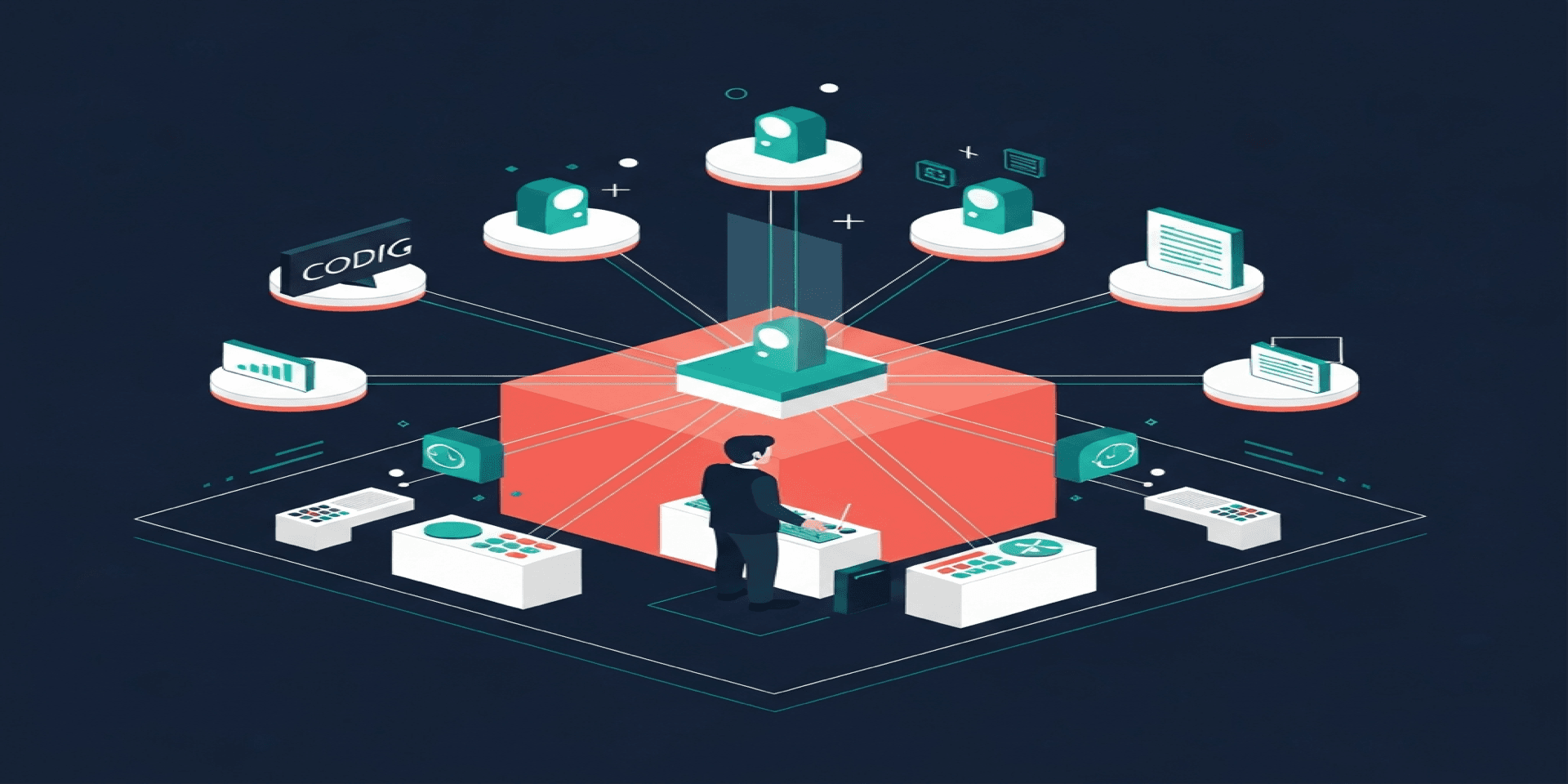
The new model looks fundamentally different. A small team of experienced developers still leads the work. But each developer now operates as an orchestrator — commanding specialized AI agents that handle the mechanical, repetitive, and verification-heavy parts of the development lifecycle. Requirements get analyzed by an agent that checks for gaps and ambiguities. Code gets audited by an agent that enforces architectural patterns and security standards. Tests get generated and executed by agents that don’t skip edge cases because it’s Friday afternoon.
The developer’s role shifts from doing everything to directing everything. And the output? It’s more consistent, more thoroughly checked, and delivered faster. Not because corners are cut, but because the work that used to consume 70% of development time — verification, coordination, quality enforcement — now happens autonomously.
What an agentic development layer looks like
An agentic development layer is a system of specialized AI agents, each responsible for a distinct phase of the software development lifecycle. Think of it like a well-run organization where every department has a clear mandate, the authority to act, and the tools to execute — except these departments run at machine speed and never call in sick.
Here’s what that typically includes:
- Requirements agents that analyze project specifications, flag contradictions, identify missing acceptance criteria, and produce structured documentation that downstream agents can consume
- Strategy agents that evaluate the existing codebase, identify integration points, and recommend implementation approaches before a single line of code is written
- Implementation agents that write code following test-driven development practices — generating tests first, then building features to pass them
- Audit agents that review every implementation phase against architectural standards, security requirements, and consistency patterns
- Testing agents that execute comprehensive test suites, verify visual output, and validate end-to-end functionality
Each agent operates autonomously within its domain. And critically, these agents don’t just assist — they enforce. Standards aren’t suggestions that developers might follow. They’re encoded into systems that verify compliance on every change, automatically.
Dan Disler, an engineer and thinker who’s been at the forefront of agentic development practices, describes this as the hierarchy of Agent > Code > Manual Input. If an agent can handle something autonomously, don’t write static code for it. If code can handle it, don’t make a human do it manually. Every task should be pushed as high up that automation chain as possible.
When you apply that principle across the entire development lifecycle, you get something powerful: a pipeline that builds your codebase, not just people who write it.
The developer as orchestrator
This shift doesn’t diminish the developer. It elevates them.
In the old model, a senior developer might spend half their day on tasks that don’t require senior-level judgment: reviewing code formatting, checking that tests cover edge cases, verifying that a new feature didn’t break an existing one, writing boilerplate documentation. Important work, but not work that requires the developer’s most valuable asset — their judgment about architecture, user experience, and business logic.
In the agentic model, agents handle verification. Humans handle judgment. The developer decides what to build and why. The agents handle the how, the did it work, and the does it meet standards.
Think of it like a film director. A great director doesn’t personally operate the camera, mix the sound, design the costumes, and edit the footage. They command specialists who handle each domain — and the director’s job is to ensure the final product tells a coherent story. The quality of the film depends on the director’s vision and the team’s execution. Both matter. Neither works alone.
This is why experience still matters enormously. An inexperienced developer commanding powerful agents is like a first-time director with a world-class crew — the raw capability is there, but without good judgment directing it, the output will be unfocused. The best results come from experienced developers who know exactly where to deploy their agents and what questions to ask.
Why the pipeline matters more than the people
Here’s the insight that changes how you should evaluate development teams: the most important investment isn’t the developers. It’s the system those developers have built to produce software.
Consider two scenarios. Team A has five talented developers who write code, manually review each other’s work, and run tests when they remember to. Team B has three developers who command an agentic pipeline that automatically analyzes requirements, enforces coding standards on every commit, runs comprehensive test suites on every change, and audits every implementation phase before it moves forward.
Team B will produce higher-quality software, faster, and more consistently. Not because their developers are better, but because their system is better. Standards are encoded, not remembered. Quality checks happen at machine speed, not at the pace of human review. Nothing ships without verification because the pipeline won’t allow it.
This is what Disler calls “building the pipeline that builds your codebase.” The pipeline is the product. The codebase is just what the pipeline produces.
For you as a client, this reframes how you should think about budgeting for software. You’re not just paying for developer hours. You’re paying for access to a system — a machine that converts requirements into tested, audited, production-ready software. The hourly rate matters less than the throughput and quality of the system behind it.
The compounding advantage
Here’s where agentic development gets really interesting: every project makes the pipeline smarter.
When a development team builds a traditional project, the knowledge stays in the developers’ heads. When they move on to the next project, that institutional knowledge doesn’t transfer cleanly. The same mistakes can happen again. The same standards need to be re-established. The same edge cases need to be re-discovered.
An agentic pipeline doesn’t forget. Every pattern it learns to check for, every quality standard it enforces, every architectural decision it encodes — those persist across every future project. The tenth project benefits from everything the pipeline learned on projects one through nine.
This creates a compounding advantage. Teams that invested early in building their agentic infrastructure are now operating at a level that’s genuinely difficult for traditional teams to match. The gap doesn’t narrow over time. It widens. Because every project teaches the pipeline something new, and every lesson is permanently encoded.
The three-phase evolution looks like this: first, AI augments what developers do — suggesting code, catching simple errors. Then, AI automates entire phases — running tests, enforcing standards, auditing implementations. Finally, some manual processes become entirely unnecessary. Not because the work doesn’t need to happen, but because the system handles it without human involvement. Augment, automate, deprecate.
Teams that have reached the third phase on core development tasks — automated testing, automated code review, automated deployment verification — are delivering at a fundamentally different speed and quality level. That advantage compounds with every project they complete.
What to ask your next development partner
If you’re evaluating development agencies or teams for your next project, the conversation needs to go beyond “do you use AI?” Everyone says yes. The real questions cut deeper:
- “What does your development pipeline look like?” — A team with an agentic layer can describe specific, autonomous systems that handle distinct phases. If the answer is “we use AI coding assistants,” that’s augmentation, not agentic development. There’s a meaningful difference.
- “How are quality standards enforced?” — Look for systemic enforcement, not human discipline. “Our developers follow best practices” is hope. “Our pipeline blocks deployments that fail automated audits” is a system.
- “What happens to knowledge between projects?” — Agentic teams encode learnings into their pipeline. Traditional teams rely on documentation that nobody reads and institutional knowledge that walks out the door with employee turnover.
- “How do you handle the trade-off between speed and quality?” — The right answer is: there is no trade-off when checks are automated. If they describe quality as something that slows them down, their process is outdated.
These questions separate teams that have genuinely invested in agentic infrastructure from teams that bolted a chatbot onto their existing workflow and called it innovation.
Frequently asked questions
Does agentic development mean AI is replacing developers?
No. It means developers are being promoted. Instead of spending time on repetitive verification tasks, they focus on architecture, business logic, and the creative problem-solving that actually requires human judgment. The agents handle the mechanical work. The developers handle the decisions that shape the product. You still need skilled humans. You just get more from each one.
Is this just a more expensive way to build software?
It’s actually less expensive in total cost of ownership. An agentic pipeline catches bugs earlier (when they’re cheap to fix), enforces standards that prevent technical debt, and delivers more consistent output with fewer revisions. The upfront investment in the pipeline pays for itself within the first project and compounds after that. Building software right the first time is always cheaper than rebuilding it later.
How do I know if a team’s agentic claims are real?
Ask for specifics. A team with a genuine agentic layer can describe which agents handle which phases, how quality gates work, and what happens when an automated audit fails. If the answer is vague — “we use AI throughout our process” — that’s marketing. If they can walk you through their pipeline stage by stage, that’s engineering.
Can any project benefit from agentic development?
Any project that involves structured software development benefits. The advantage is most pronounced on projects with complex business logic, strict quality requirements, or tight timelines — which is most projects worth building. Simple landing pages probably don’t need a full agentic pipeline. Custom web applications, SaaS platforms, and business-critical tools absolutely do.
The system behind the software
When you hire a development team, you’re not just hiring the people in the room. You’re hiring every system, process, and tool those people bring with them. The best teams have invested years building agentic infrastructure that multiplies their output, enforces their standards, and compounds their expertise across every project.
The question for your next project isn’t whether AI should be involved. That ship has sailed. The question is whether you’re hiring a team that uses AI as a novelty — or one that’s built the pipeline that builds your codebase.
We’ve built that pipeline. If you want to see what agentic development looks like in practice, let’s talk about your project.